
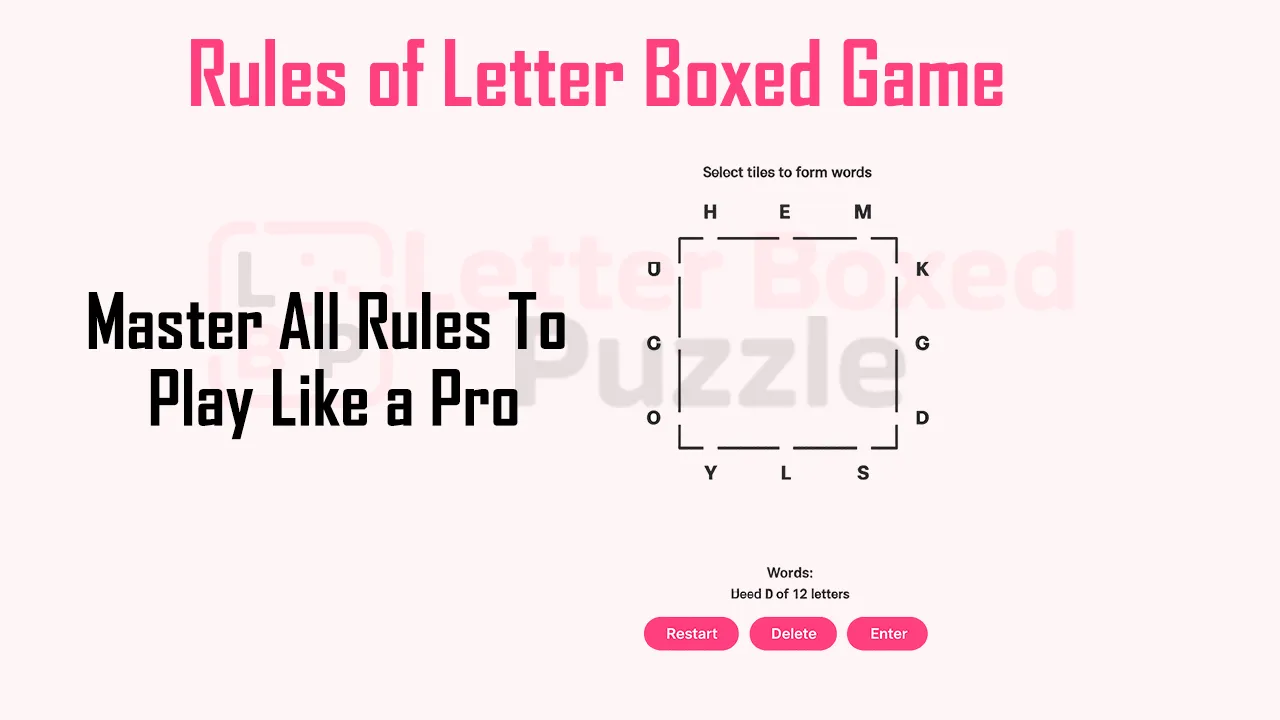
Rule #1: Letter Coverage Requirement
Official Statement:
A valid solution must include every letter present on the game board at least once within the complete word chain.
Technical Details
- ➥ Count: 12 letters on board (some may repeat).
- ➥ Requirement: Each unique letter appears at least 1 time in your solution.
- ➥ Verification: Post-solution, the game highlights any unused letters.
- ➥ Repeated Letters: If a letter appears on multiple sides, using it once satisfies the requirement for all instances.
Edge Case #1: Duplicate Letters
Scenario: Board contains T (top) and T (bottom). Must you use both T's?
Official Answer: No, Using T once satisfies the letter T requirement, regardless of which position you used.
- Example: TROPES → STORED , T used once , all unique letters covered.
Edge Case #2: Letter Reuse
Scenario: Can you use the letter E five times across your word chain?
Official Answer: Yes, The rule states "at least once," not "exactly once."
- Word 1: EXTREME (E used 3 times)
- Word 2: ENTERED (E used 2 more times)
- Total E usage: 5 times :completely valid.
Edge Case #3: Partial Coverage
Scenario: You used 11 of 12 letters. Is partial credit given?
Official Answer: No, Letter Boxed is binary , complete (all letters used) or incomplete. Partial solutions cannot be submitted.
- ➥ Incomplete solutions show remaining letters highlighted.
- ➥ No submission is allowed until 100% coverage is achieved.
Rule #2: Same-Side Restriction
Official Statement: Within a single word, consecutive letters may not be selected from the same side of the square.
Technical Specification
- ➥ The square has 4 sides: Top, Right, Bottom, Left : letters are permanently assigned to sides.
- ➥ "Consecutive" means letter N and letter N+1 in sequence : not adjacent board positions.
Valid Side Transitions
- ALLOWED: Top → Right, Top → Bottom, Top → Left (and all other cross-side transitions).
- FORBIDDEN: Top → Top, Right → Right, Bottom → Bottom, Left → Left.
Edge Case #4: Same Letter, Different Sides
Scenario: Letter A appears on the top side and the right side. Can you use Top-A then Right-A consecutively?
Official Answer: Yes, They are on different sides, so the transition is allowed.
- ➥Example: A (top) → D (right) → A (top) : Top→Right , Right→Top Valid.
- ➥Key point: The letter itself doesn't matter, only which side it's on.
Edge Case #5: Non-Consecutive Same-Side
Scenario: Can you use two letters from the same side if there's a letter from a different side between them?
Official Answer: Yes, The restriction only applies to consecutive (adjacent in sequence) letters.
- ➥ Example : MEATS: M (top) → E (right) → A (top) → T (right) → S (?)
- ➥ M and A are both from top, but E separates them . Valid.
- ➥ Compare : MARKET: M (top) → A (top) consecutive same-side . Invalid.
Rule #3: Word Chaining Requirement
Official Statement: Each word after the first must begin with the final letter of the preceding word, forming an unbroken chain.
Technical Specification
- Word 1: TRADE (last = E) → Word 2: EMPIRE (first = E) . Valid chain.
- Word 1: TRADE (last = E) → Word 2: SIMPLE (first = S) . Breaks chain.
Edge Case #6: Same Starting and Ending Letter
Scenario: Can a word start and end with the same letter?
Official Answer: Yes, If that letter exists on the board.
- ➥ Example: ARENA (starts A, ends A) → ATLAS → SCORED
- ➥ Strategic note: This can help create useful "loops" in your chain.
Edge Case #7: Single-Word Solution
Scenario: Can your entire solution be one word?
Official Answer: Theoretically yes, If one word uses all 12 letters. In practice, this is extremely rare , most boards do not support a 12-letter word that also satisfies the same-side restriction.
Rule #4: Minimum Word Length
Official Statement: Each word must contain a minimum of three (3) letters.
Technical Specification
- 1-letter words: Auto-rejected.
- 2-letter words: Auto-rejected.
- 3+ letter words: Validated against the dictionary.
- Maximum word length: None , longer words are encouraged as they cover more letters.
Edge Case #8: Hyphenated or Compound Words
Scenario: Does "self-aware" count as 9 letters?
Official Answer: No, Hyphenated words are not accepted , the game only accepts continuous letter strings without punctuation.
- "self-aware" (hyphenated) : Rejected.
- "everywhere" (compound, no hyphen) : Accepted.
Edge Case #9: Abbreviations and Acronyms
Scenario: Does "USA" count as a valid 3-letter word?
Official Answer: No. Acronyms and abbreviations are not valid entries.
- Rejected: USA, FBI, NASA, Dr., St., OK, TV, ID.
- Accepted: USE, FIB (valid dictionary words).
Rule #5: Dictionary Validation
Official Statement: All words must be present in the standard English dictionary used by the game.
Accepted Word Categories
- Base words: Nouns (HOUSE, TREE), verbs (RUN, THINK), adjectives (BLUE, FAST), adverbs (QUICKLY).
- Inflected forms: Plurals (CATS, BOXES), past tense (WALKED, RAN), present participle (RUNNING), past participle (BROKEN).
- Derived forms: Comparatives (FASTER), superlatives (FASTEST), agent nouns (RUNNER, TEACHER).
- Compound words: EVERYWHERE, SOMETHING, BASKETBALL , single-word compounds only (no hyphens).
Rejected Word Categories
- Proper nouns: JOHN, LONDON, GOOGLE, KLEENEX.
- Abbreviations & acronyms: USA, DR., HTML, CSS.
- Slang & informal: GONNA, WANNA, LOL, OMG.
- Non-English words: BONJOUR, GRACIAS (unless adopted into English, e.g., CAFE, RESUME).
- Hyphenated words: WELL-BEING, X-RAY, E-MAIL.
- Contractions: CAN'T, WON'T, IT'S (use CANNOT or WONT instead).
Edge Case #10: British vs. American Spelling
Official Answer: The game generally accepts both spellings.
- ➥COLOR (American) and COLOUR (British) - Both Valid.
- ➥REALIZE (American) and REALISE (British) - Both Valid.
Edge Case #11: Obscure but Valid Words
Scenario: You tried a valid-sounding word but it was rejected. Is the dictionary limited?
Official Answer: The dictionary is comprehensive but not exhaustive. Extremely technical jargon, highly specialized terms, and ultra-rare words may be excluded.
- ➥ Tip: If a word is rejected, try a more common synonym.
Rule Violation Troubleshooting
Error: "Letters from Same Side"
- ➥ Identify which side each letter is on.
- ➥ Check each consecutive letter pair in your word.
- ➥ Find and fix the violating pair.
- ➥ Example: MASTER , M (top) → A (top)
- ➥ Fix: Choose a word that alternates sides from the start.
Error: "Word Doesn't Connect"
- ➥ Your previous word's last letter does not match your current word's first letter.
- ➥ Example: TRADE (ends E) → SIMPLE (starts S)
- ➥ Fix: Find a word starting with E (EMPIRE, ENTER, EAGLE).
Error: "Word Too Short"
- ➥ Your word has fewer than 3 letters. Add more letters or choose a different word.
Error: "Not a Valid Word"
- ➥ Check spelling carefully.
- ➥ Verify it is a common English dictionary word.
- ➥ Confirm it is not a proper noun, abbreviation, or slang term.
- ➥ Try a common synonym if the word seems valid but is still rejected.
Rule Enforcement Matrix
All five rules are enforced automatically by the game , it is impossible to accidentally submit a rule-breaking solution.
| Rule | Auto-Enforced? | User Warning? | Rejection Method |
|---|---|---|---|
| All letters used | Yes | Highlights missing letters | Prevents submission |
| Same-side restriction | Yes | Error message | Immediate rejection |
| Word chaining | Yes | Error message | Immediate rejection |
| Minimum length | Yes | Error message | Immediate rejection |
| Valid word | Yes | "Not in dictionary" | Immediate rejection |
Quick Recap: All Letter Boxed Rules at a Glance
- Use all 12 letters at least once.
- No consecutive letters from the same side within a word.
- Words must connect in a chain (last letter → first letter).
- Minimum word length: 3 letters.
- Only standard English dictionary words are accepted.
- No proper nouns, abbreviations, slang, or hyphenated words.
- Letters may be reused freely , each must appear at least once.
- All rules apply equally in both Daily and Unlimited modes.
- All five rules are automatically enforced , no accidental violations possible.
Conclusion
Mastering the rules of Letter Boxed is the foundation for consistently valid solutions, whether you play the Letter Boxed Daily or practice in Letter Boxed Unlimited. The five core rules , full letter coverage, the same-side restriction, word chaining, minimum word length, and dictionary validation , work together to create a puzzle that is simple to understand but genuinely challenging to master.
Because every rule is enforced automatically, you can focus entirely on strategy: planning your chain, spotting bridge letters, and hunting for that satisfying two-word finish. Refer back to this guide whenever an edge case trips you up, use the troubleshooting section to diagnose unexpected rejections quickly, or try our Letter Boxed Solver to find valid word chains when you're stuck.