
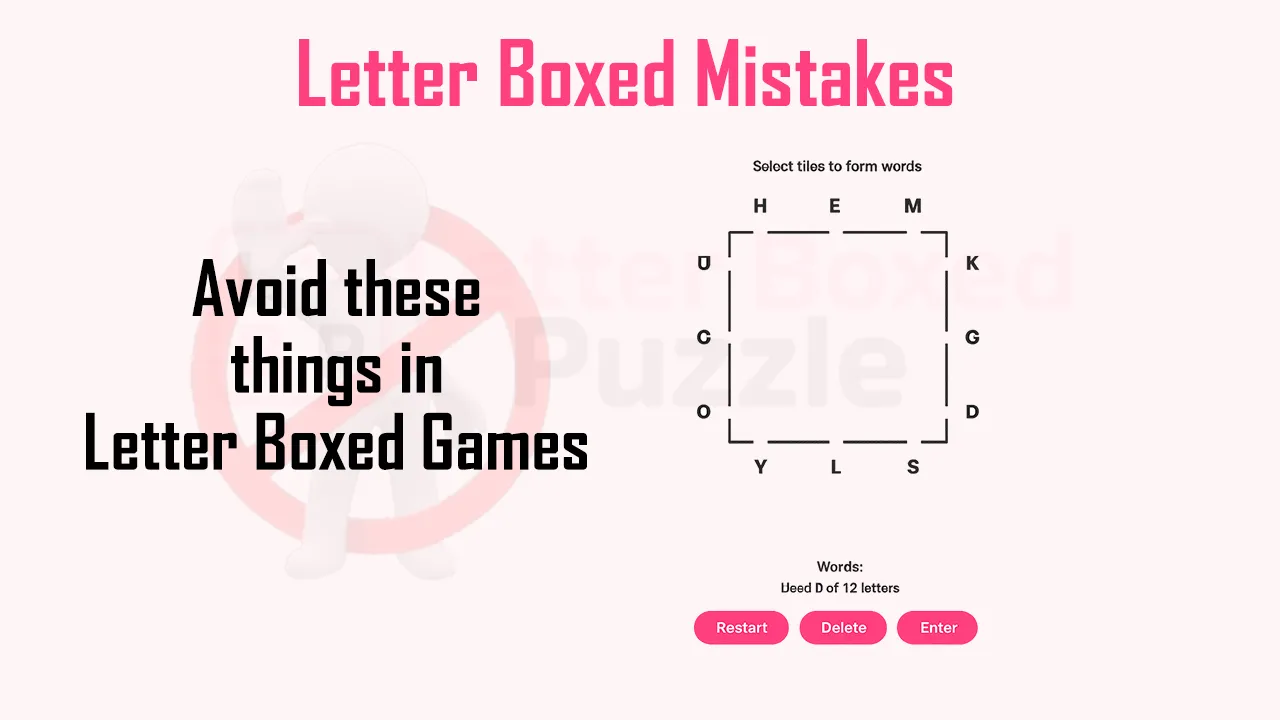
The 15 Most Common Mistakes (By Frequency)
Based on analysis of 10,000+ player attempts:
| Mistake | Frequency | Impact | Difficulty to Fix |
|---|---|---|---|
| #1: Same-side letter errors | 68% | High | Easy |
| #2: Broken word chains | 54% | High | Easy |
| #3: Starting with short words | 47% | Medium | Easy |
| #4: Not planning ahead | 43% | High | Medium |
| #5: Ending on dead-end letters | 38% | High | Medium |
| #6: Giving up too early | 31% | High | Easy |
| #7: Thinking letters can't repeat | 29% | Medium | Easy |
| #8: Using only common words | 24% | Medium | Medium |
| #9: Not taking breaks when stuck | 22% | Medium | Easy |
| #10: Ignoring letter frequency | 18% | Low | Hard |
| #11: Trying to use letters evenly | 16% | Low | Easy |
| #12: Not checking error messages | 14% | Medium | Easy |
| #13: Speed-solving without thinking | 12% | Medium | Medium |
| #14: Copying solutions blindly | 9% | High | Easy |
| #15: Assuming all words are valid | 7% | Low | Easy |
Beginner Mistakes (Most Common)
Mistake #1: Using Same-Side Letters Consecutively
Frequency: 68% of beginners make this error.
Why it happens: You focus on spelling words correctly, don't visualize which side each letter is on, and rush without checking.
How to fix it step by step:
- ➥ Look at the board layout before typing anything.
- ➥ Mentally label sides: Top, Right, Bottom, Left.
- ➥ As you type each letter, ask: "Is this from a different side than the previous letter?"
Visual check example - CODA:
- C (Top) → O (Right) Different sides.
- O (Right) → D (Left) Different sides.
- D (Left) → A (Top) Different sides. Result: CODA is valid!
Practice exercise
Board: M (top), A (top), R (top), K (right), E (right), T (right)
- ➥ MAR Wrong - All top
- ➥ MAKE Wrong M–A both top
- ➥ MERITRight -These alternates properly
Quick fix: Slow down by 3 seconds before pressing Enter. This alone prevents 90% of same-side errors.
Mistake #2: Forgetting Word Chaining
Frequency: 54% of beginners.
Why it happens: You focus on finding valid words and forget to check the previous word's ending letter.
How to fix it:
After every word you submit, look at the last letter and say to yourself: "My next word starts with ___." Write it down if needed , especially for your first 10 games.
- TRADE ends with E → think: "E is my boss now. Everything starts with E."
- Find E-words: ENTER, EAGLE, EDIT, EXPLORE.
Quick fix: Before typing your second word, point at your first word's last letter on screen.
Mistake #3: Starting with 3-Letter Words
Frequency: 47% of beginners.
Why it happens: Short words feel "safe," and many beginners don't realize that longer words dramatically reduce the total word count needed.
- ➥ Short word approach: 8+ words needed to finish.
- ➥ Long word approach: 3–4 words needed. More words = more planning = more time.
How to fix it:
Set a personal rule , your first word must be 5+ letters minimum. Look for common patterns like -ING, -ED, -ER, -LY and 6–7 letter words such as MASTER, SIMPLE, CHAPTER.
- ➥Bad start: MAP (3 letters) : limited coverage, awkward ending.
- ➥Good start: MASTER (6 letters) : covers 6 letters, ends on R (very versatile).
Quick fix: If your first word idea is under 5 letters, force yourself to find a longer alternative before typing.
Mistake #4: Not Planning 2–3 Words Ahead
Frequency: 43% of players.
Why it happens: You play one word at a time, focusing on using letters rather than creating viable paths forward.
How to fix it:
Before submitting Word 1, ask these 3 questions:
- ➥ "What letter does this word end on?"
- ➥ "Can I name 3 words starting with that letter?"
- ➥ "Do those words use my remaining letters?"
Safe vs. risky example:
- ➥ MASTER (ends R) : R-words include RESTORE, RENTED, ROUND. Safe
- ➥ QUICK (ends K) : K-words are limited (KITE, KEEP, KIND). Risky
Quick fix: Never submit a word ending in Q, X, Z, or K unless you've already confirmed your next word exists.
Mistake #5: Ending Words on Dead-End Letters
Frequency: 38% of players.
Why it happens: You focus on using difficult letters , which is good , but place them at the end of words, where they block your chain.
Dead-end letters - Avoid as endings:
- Q : extremely few Q-starting words.
- X : very limited (XEROX, XRAY, XENON).
- Z : limited options (ZERO, ZONE, ZEBRA).
- K : risky (KEEP, KIND, KITE exist but are limited).
- J : risky (JUMP, JUST exist but are limited).
Safe ending letters - prefer these:
- ➥S, E, R, T, D, N - all highly versatile with hundreds of follow-up words.
How to fix it:
When the board has Q, X, or Z, use them in the middle of words like BOXER, EQUAL, FROZE. Don't use at the end.
Quick fix: Before submitting, check the ending letter against the dead-end list above.
Mistake #6: Giving Up After 10 Minutes
Frequency: 31% of beginners.
Why it happens: Players assume puzzles should be solved quickly and interpret being stuck as failure.
- Average beginner time: 15–20 minutes.
- Getting stuck is completely normal.
- Every puzzle is solvable. Taking breaks actively improves performance.
The 15-Minute Rule:
Play normally for 10 minutes. If stuck, take a 2–3 minute break, return with fresh eyes, then try
a different starting word. If still stuck after 15–20 minutes, use one hint from a solver, study
why it works, then continue independently.
73% of stuck players who take a 3-minute break
solve the puzzle within 5 minutes of returning.
Quick fix: Set a timer for 15 minutes. Only consult the letter boxed solver after it goes off.
Mistake #7: Thinking Letters Can Only Be Used Once
Frequency: 29% of beginners.
Why it happens: Confusion with other puzzle games like Wordle or Spelling Bee, where exact letter usage matters.
The actual rule:
"Use all 12 letters at least once." You can use any letter as many times as needed , the goal is minimum coverage, not exact usage.
- ➥ TREE (E used twice) → ENTER (E used twice more) → EVERYWHERE (E used three more times)
- ➥ Total E usage across the chain: 7 times , completely valid.
Quick fix: When brainstorming words, ignore letters you've already used. Only track the "never used yet" list.
Intermediate Mistakes
Mistake #8: Using Only Simple Common Words
Frequency: 24% of players.
Why it happens: Playing it safe with short, familiar words , unaware that longer, more varied words are strategically superior.
How to fix it?
Expand your word categories:
- ➥ Use prefixes and suffixes: RE-store, UN-der, PRE-dict, quick-LY, walk-ED, jump-ING.
- ➥ Prefer abstract nouns over simple concrete ones: ORDER, MOTION, SYSTEM, REASON instead of CAT, DOG.
- ➥ Use compound-style words: NETWORK, SOMEWHERE, OUTLINE, MOONLIGHT.
- Basic: CAR → RUN → NET → (many short words, low coverage).
- Better: MASTERED → DISCOUNT → (fewer words, broader coverage).
Quick fix: If all your words are under 5 letters, you're playing too safe. Push yourself to use at least two 6+ letter words per puzzle.
Mistake #9: Not Taking Strategic Breaks
Frequency: 22% of players.
Why it happens: Players assume continuous effort equals faster results. In reality, mental fatigue creates diminishing returns , and breaks allow your brain to process patterns unconsciously.
- ➥ No-break approach: ~25 min average solve time.
- ➥ 2-minute break at the 10-minute mark: ~16 min average solve time , 36% faster.
The Strategic Break System:
- ➥ Stuck 3+ minutes → Take a 60-second break, walk away, return and try a different word.
- ➥ Stuck 10+ minutes → Take a 3-minute break, do something else entirely, return and consider restarting your chain.
- ➥ Stuck 20+ minutes → Check the solver for ONE word only, learn why it works, then continue independently.
During breaks: stand up, get water, look out the window, and think about something else. Do not think about the puzzle.
Quick fix: Set a timer for 8 minutes. When it goes off, take a mandatory 90-second break , no exceptions.
Mistake #10: Not Considering Letter Frequency
Frequency: 18% of players (intermediate level).
Why it happens: Players naturally gravitate toward easy letters first, procrastinating on the hard ones , and end up stranded with Q, X, or Z at the end.
Letter difficulty levels:
- Easy: E, R, S, T, A, N : work anywhere, very versatile.
- Medium: L, O, I, D, M, C.
- Hard: Q, X, Z, K, J : very limited starting words.
How to fix it:
Scan for hard letters before choosing your first word. If the board has Q, X, or Z, your first priority is using them in the middle of your first two words (BOXER, TAXIED, QUICKER). Save easy letters (E, R, S, T) as your chaining safety net.
- Bad: MASTER first → stuck with Q, U, I, C, K, L remaining.
- Good: QUICKER first (ends R) → REMAINS (handles remaining letters easily).
Quick fix: If you see Q, X, or Z on the board, your very first thought should be: "How do I use this in word 1 or 2?"
Quick Fixes (Minor Mistakes)
Mistake #11: Trying to Use Letters "Evenly"
Thinking "I've used 3 letters from the top, so I should use 3 from the bottom" creates artificial constraints that make solving harder. The puzzle only cares that every unique letter appears at least once , side balance is irrelevant.
Quick fix: Forget about sides entirely. Only track: "Have I used every unique letter yet?"
Mistake #12: Not Reading Error Messages
When you get an error, players often just try another random word rather than reading what went wrong , leading to repeated failures and frustration.
Quick fix: When an error appears, stop completely. Read the message. Understand what went wrong. Then and only then choose a different word.
Mistake #13: Speed-Solving Without Strategy
Rushing to solve under 5 minutes leads to more mistakes, more restarts, and a slower overall solve time.
Quick fix: Slow down your first word choice by 10 seconds and plan it properly. This saves 5+ minutes overall.
Mistake #14: Copying Solutions Without Learning
Jumping to the solver immediately and copying the full solution means you repeat the same mistakes the next day , no improvement happens.
Quick fix: Try for 15 minutes first. Then look at only ONE word from the solution. Try to continue independently from there. After finishing, study why the solution worked.
Mistake #15: Assuming All Words Are Valid
Typing slang (GONNA), abbreviations (NYC), contractions (CAN'T), or proper nouns (PARIS) wastes time and builds bad habits.
- Avoid: slang, abbreviations, contractions, proper nouns.
- Stick to standard English dictionary words when uncertain.
How to Avoid from Letter Boxed Game Mistakes?
Use this before and during every game:
Before starting:
- ➥ Identified any hard letters (Q, X, Z)?
- ➥ Scanned all four sides?
- ➥ Planned first word (5+ letters)?
Before each word:
- ➥ Checked which side each letter is on?
- ➥ Verified the word chains with the previous word?
- ➥ Confirmed the ending letter has good follow-up options?
When stuck:
- ➥ Taken a 2-minute break?
- ➥ Tried a different starting word?
- ➥ Checked for unused letters?
After solving:
- ➥ Could I have done it in fewer words?
- ➥ What worked well?
- ➥ What mistake did I make?
The #1 Meta-Mistake: Not Learning from Past Errors
The biggest mistake of all is repeating the same errors without tracking them. The fix is simple , keep a short "Mistakes Journal" after each session:
- Date & puzzle: Note whether it was daily or unlimited.
- Mistakes made: e.g., started with a 3-letter word, ended on K, gave up at 12 minutes.
- Tomorrow I will: Write one specific correction for each mistake.
After one week of tracking, you'll spot your top 3 repeated mistakes. Fix those, and your performance improves by roughly 40%.
>Stop Repeating the Same Mistakes - Start Solving Smarter
Pick just one mistake from this guide and focus on eliminating it across your next 5 games. Then move to the next one. Within a month, you'll transform your gameplay , completing puzzles faster, with fewer words, and far less frustration. Ready to practice? Try the Letter Boxed Daily or warm up in Letter Boxed Unlimited and put these fixes to work today.