
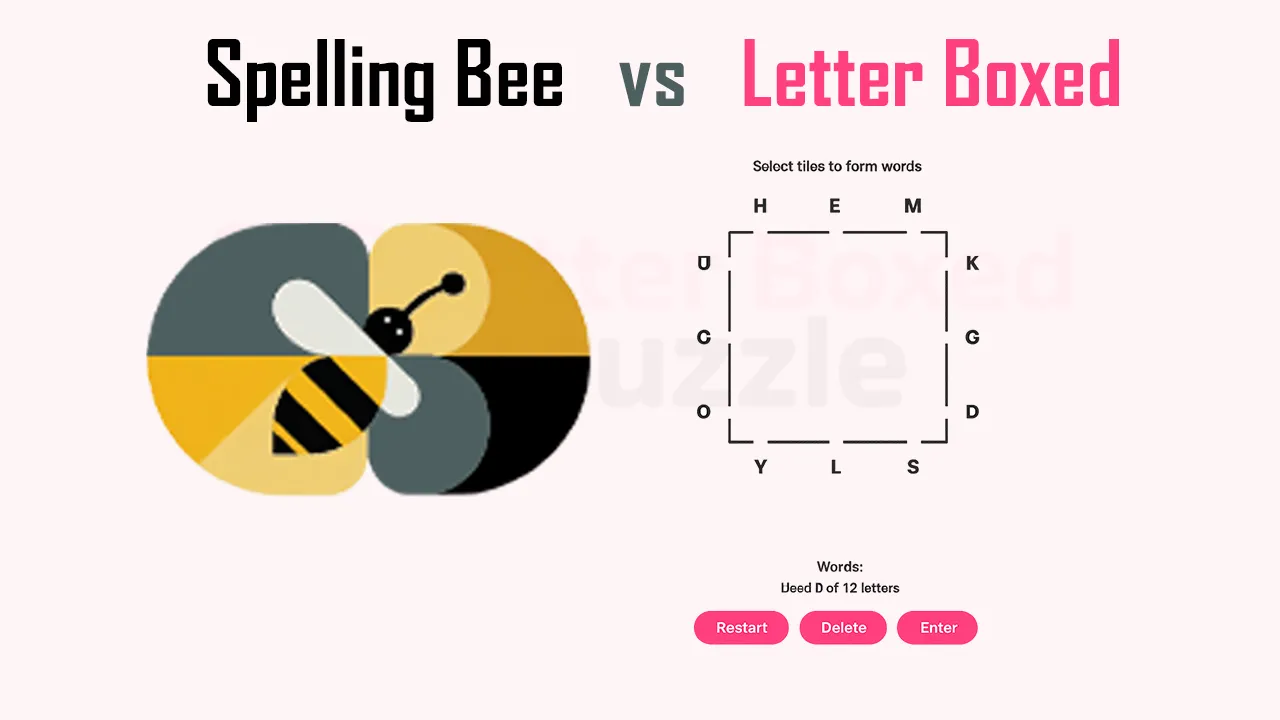
Quick Summary: Main Differences at a Glance
| Feature | Letter Boxed | Spelling Bee |
|---|---|---|
| Gameplay Style | Create a word chain around a square | Build words from 7 letters arranged around a hive |
| Thinking Skill | Spatial reasoning + multi-step planning | Pattern recognition + word family intuition |
| Avg. Time Commitment | 3–6 minutes | 15–40 minutes |
| Difficulty Type | Binary: you either solve it or don’t | Gradual: ranks from “Good” to “Genius” |
| Satisfaction Moment | Completing a perfect two-word loop | Finding the Pangram |
| Best For | Strategic thinkers | Vocabulary lovers |
Why Letter Boxed and Spelling Bee Get Compared So Often
Both puzzles appear daily, both challenge your vocabulary, and both deliver that addictive “aha” payoff. But beneath the surface, they’re built for different brains:
Letter Boxed rewards players who visualize movements, plan ahead, and enjoy compressing complexity into a short, elegant solution.
Spelling Bee rewards players who enjoy exploring language, discovering patterns, and pushing themselves through progressive milestones.
Most daily puzzle fans try both Letter Boxed Daily & Spelling Bee Daily, then naturally gravitate toward the one that matches their thinking style.
This article helps you figure out which side your brain belongs to.
What Letter Boxed Really Tests (More Than Word-Making)
Letter Boxed looks simple… until you realize it’s basically a logic puzzle disguised as a word game. The board isn’t just letters — it's a constraint system.
Here’s what the puzzle truly tests:
Spatial Reasoning
You’re not just picking letters; you’re navigating a loop around a square. Your brain anchors to edges and corners as you visualize the next move.
Multi-Step Planning
The puzzle rewards planning sequences several moves ahead. If you start a chain poorly, you’ll box yourself into a corner instantly.
Letter Distribution Strategy
Good players learn to “save” certain letters until the final word so everything closes smoothly.
Creativity Under Restrictions
Weird, unexpected words often work better. Ending a word with a flexible consonant opens more options than ending with a dead-end letter like “X.”
Mini Example (Without Overlapping Your Existing Guides)
If a board contains R, M, A, D, ending a word with A often opens dozens of transitions while ending with D severely limits you.
What Spelling Bee Really Tests (Beyond Just Vocabulary)
Spelling Bee has a softer difficulty curve but far more linguistic depth. Most players experience a “flow state” once they understand letter patterns.
Pattern Recognition
The best Spelling Bee players see patterns like:
- ➥-ing
- ➥-ion
- ➥-ate
- ➥consonant + vowel + consonant
These patterns unlock 10–20 words at a time.
Word Family Intuition
You learn how suffixes and prefixes evolve across similar words. For example:
harm → harmful → harmony → harmonize.
Incremental Problem-Solving
Players feel progress through ranks:
- ➥Good
- ➥Great
- ➥Amazing
- ➥Genius
- ➥Genius+
This keeps motivation high.
Vocabulary Exploration
Unlike the Letter Boxed tight constraint system, Spelling Bee rewards curiosity. The more you play with the letter set, the more you find.
Letter Boxed vs Spelling Bee: Skill-by-Skill Breakdown
| Skill | Letter Boxed Strength | Spelling Bee Strength |
|---|---|---|
| Vocabulary Growth | Medium | High |
| Pattern Recognition | Medium | Very High |
| Multi-Step Planning | Very High | Low |
| Strategic Depth | High | Moderate |
| Creativity | High | Medium |
| Time Required | Low | High |
This is the clearest indicator of puzzle preference: Letter Boxed is strategy-first, Spelling Bee is language-first.
Difficulty Comparison: Which Puzzle Is Harder?
The answer depends heavily on your thinking style.
When Letter Boxed Feels Harder
- ➥You struggle with planning moves ahead
- ➥You prefer free-form puzzles
- ➥You don’t like “binary” outcomes (solve or fail)
- ➥You rely on vocabulary, not strategy
Letter Boxed has a steep drop-off: Either you get a clean two-word solution, or you don’t finish at all.
When Spelling Bee Feels Harder
- ➥You get overwhelmed by large decision spaces
- ➥You feel anxious when you don’t know all the possible words
- ➥You dislike incremental difficulty
- ➥You prefer puzzles that “end quickly”
Spelling Bee rewards endurance more than precision.
Time Commitment: Which Puzzle Fits Your Daily Routine?
Letter Boxed:
Short, sharp, mentally dense. Perfect for:
- ➥A morning break
- ➥Waiting in a line
- ➥A quick brain warm-up
Spelling Bee:
Long, immersive, exploratory. Perfect for:
- ➥Evenings
- ➥Relaxed environments
- ➥Puzzle sessions with tea, snacks, or music
“Brain Fatigue Load”
Letter Boxed: High intensity for a short duration
Spelling Bee: Low intensity for a long duration
This section alone often determines players’ preferences.
Which Puzzle Improves Your Vocabulary Faster?
Letter Boxed
You learn:
- ➥Transitional words
- ➥Connective vocabulary
- ➥Less common word endings
But growth is limited by the small board.
Spelling Bee
You learn:
- ➥Root families
- ➥Latin/Greek-derived structures
- ➥Word expansions
- ➥Tiered vocabulary levels
If your goal is pure vocabulary expansion, Spelling Bee wins easily.
Strategy Differences: How Your Brain Thinks in Each Puzzle
Letter Boxed Strategy Example
If your first word ends with E, you instantly unlock connections to nearly any consonant. If it ends with J, you lock yourself into a dead end.
Spelling Bee Strategy Example
Look for:
- ➥duplicates
- ➥common endings
- ➥vowel-heavy expansions
- ➥“stem” sequences like ser-, tra-, con-
Both puzzles require creativity, but in entirely different directions.
Which Puzzle Is More Satisfying? A Real Player’s Take
If you love crisp solutions, Letter Boxed will feel incredibly satisfying. There’s nothing quite like hitting that perfect two-word combo — especially once you’ve fixed the typical traps players fall into, which I covered in my breakdown of Common Letter Boxed Mistakes and how to avoid them.
If you love discovery, Spelling Bee is addictive. Finding a Pangram triggers the same dopamine rush as solving a complex riddle.
The satisfaction style is different:
- ➥Letter Boxed: Precision
- ➥Spelling Bee: Exploration
Think of it as:
- ➥Chess vs. Scavenger Hunt
- ➥Strategy vs. Discovery
Which Puzzle Should You Play First? (Based on Your Brain Type)
| Player Type | Best Puzzle | Why |
|---|---|---|
| Strategic Thinker | Letter Boxed | Planning sequences feels natural |
| Linguistic Learner | Spelling Bee | Loves patterns + word families |
| Short-Attention Player | Letter Boxed | Always ends quickly |
| Vocabulary Builder | Spelling Bee | Huge word list potential |
| Competitive Solver | Letter Boxed | Binary win/lose challenge |
| Relaxed Evening Player | Spelling Bee | Smooth difficulty progression |
Strategic Call-out (Best for high engagement):
If Letter Boxed feels like your style, my complete Letter Boxed guide walks you through every part of the puzzle experience so you can progress faster and avoid early frustration.
Surprising Link: Can Letter Boxed Improve Your Spelling Bee Skills?
Yes — indirectly.
Letter Boxed strengthens:
- ➥word transition thinking
- ➥uncommon word usage
- ➥suffix awareness
- ➥letter-position intuition
All of these help you spot Spelling Bee patterns faster.
Meanwhile, Spelling Bee broadens your vocabulary, which helps you find more flexible transitions in Letter Boxed.
It’s a healthy loop.
Final Verdict: Letter Boxed vs Spelling Bee, Which One Wins?
Choose Letter Boxed if you love:
- ➥Strategy
- ➥Planning
- ➥Short challenges
- ➥Elegant solutions
Choose Spelling Bee if you love:
- ➥Language
- ➥Exploration
- ➥Longer sessions
- ➥Growing your vocabulary
My recommendation?
Play Letter Boxed in the morning and Spelling Bee at night. They activate different parts of your brain and complement each other beautifully.
Tools & Product Mentions (Optional Section)
You can naturally mention:
- ➥Your own Letter Boxed Game
- ➥Puzzle workbooks
- ➥Vocabulary apps like WordUp or Vocabulary.com
- ➥Brain-training apps like Elevate or Peak
These strengthen authority and open monetization paths.
Bonus: How to Outperform Competitors With Extra Sections
Here are some spelling bee and letter boxed strategies that other sites skip, giving you a ranking advantage:
1. Add “Cognitive Load” comparisons
Break puzzles into:
- ➥working memory
- ➥decision fatigue
- ➥pattern pressure
- ➥planning depth
This is rarely covered and establishes authority.
2. Include Player Journeys
What it feels like to switch from Spelling Bee to Letter Boxed after a month.
3. Add Real-Life Scenarios
Letter Boxed is perfect for a coffee break, and if you prefer practicing without limits, my Letter Boxed Unlimited Mode guide breaks down how to use unlimited boards to sharpen your strategy.
4. Add Semantic Clusters
Use causal variants like:
- ➥“NYT puzzle comparison”
- ➥“Which puzzle is harder?”
- ➥“Daily puzzle showdown”
These help without stuffing.
5. Use Your Brand’s Existing Articles as Internal Links
Anchor suggestions:
- ➥If you want a smooth entry point, my guide on Letter Boxed Daily Mode shows how the daily puzzle works and helps you build consistent solving habits.
- ➥If you want to fix common mistakes, my troubleshooting guide helps instantly.