
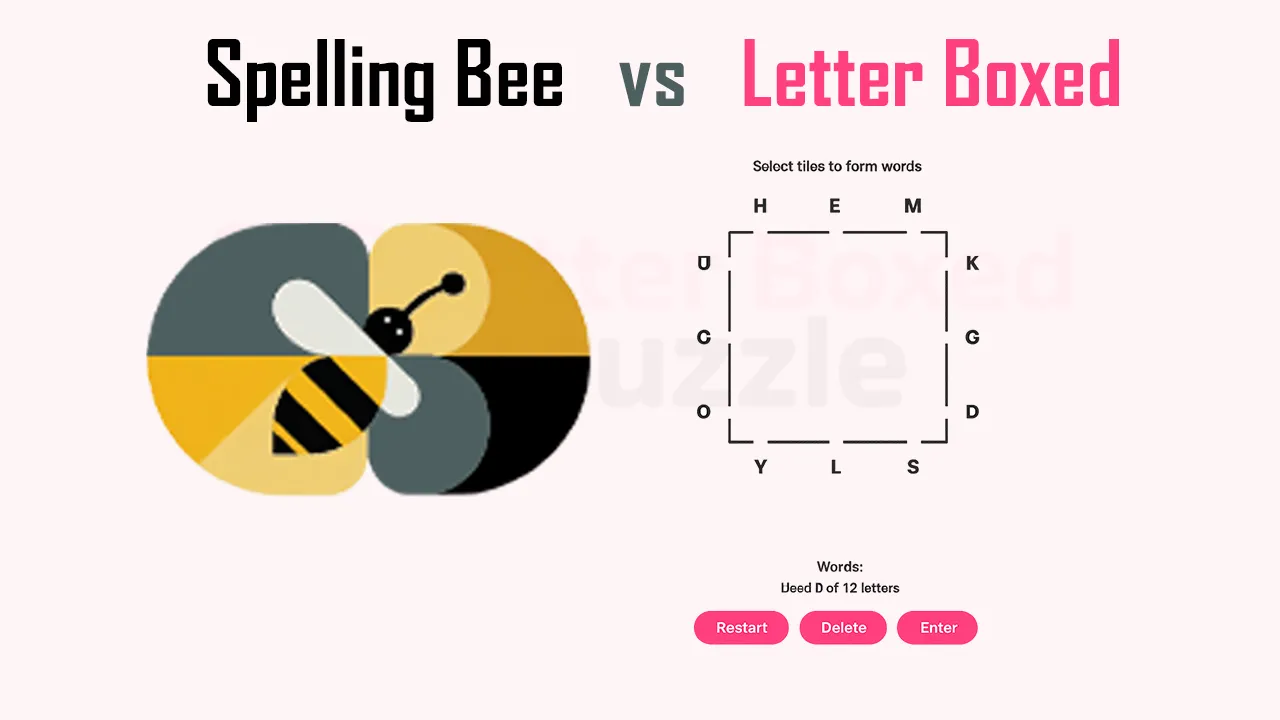
Which Puzzle Should You Play?
Letter Boxed is best for:
- ➥ Strategic thinkers who love planning multi-step sequences.
- ➥ Players who want quick, intense 3–6 minute challenges.
- ➥ People who enjoy elegant, efficient solutions.
- ➥ Competitive solvers who like binary win/lose outcomes.
Spelling Bee is best for:
- ➥ Vocabulary lovers who enjoy discovering word patterns.
- ➥ Players who prefer relaxed 15–40 minute sessions.
- ➥ People who like progressive achievement systems (Good → Genius).
- ➥ Exploratory learners who love linguistic discovery.
Can't decide? Play Letter Boxed in the morning (quick brain warmup) and Spelling Bee in the evening (relaxing exploration).
Letter Boxed vs Spelling Bee: Main Differences at a Glance
| Feature | Letter Boxed | Spelling Bee |
|---|---|---|
| Gameplay Style | Create word chains around a square | Build words from 7 letters in a hive |
| Core Skill | Spatial reasoning + multi-step planning | Pattern recognition + word families |
| Time Required | 3–6 minutes average | 15–40 minutes average |
| Difficulty Type | Binary: solve or don't | Gradual: Good → Genius progression |
| Best Moment | Perfect 2-word solution | Finding the Pangram |
| Mental Style | Strategic, chess-like | Exploratory, discovery-based |
| Vocabulary Growth | Medium (focused on transitions) | High (word family expansion) |
| Replay Value | Daily puzzle + unlimited mode | Daily puzzle only |
| Frustration Type | Getting stuck in dead-ends | Missing obscure words |
| Satisfaction Style | Precision and elegance | Discovery and achievement |
| Best For | Strategic thinkers | Language enthusiasts |
Why Letter Boxed vs Spelling Bee Gets Compared So Often
Both puzzles appear in the New York Times Games collection, offer daily challenges, test vocabulary and word skills, deliver addictive "aha!" moments, and have passionate communities. But beneath the surface, they're fundamentally different:
- Letter Boxed = Logic puzzle disguised as word game. Rewards visualization, planning, efficiency. Gameplay is constrained pathfinding with a goal of elegant solutions in minimal words.
- Spelling Bee = Language exploration disguised as word game. Rewards pattern recognition and vocabulary breadth. Gameplay is open-ended discovery with a goal of finding as many words as possible.
Most players try both, then naturally gravitate to one. This guide helps you figure out which matches your brain.
What Letter Boxed Really Tests (Beyond Word-Making)
Letter Boxed looks simple until you realize it's a constraint-based logic puzzle with words as the medium.
Spatial Reasoning
You're navigating a physical loop around a square, not just picking letters from a list. Your brain anchors to edges and corners, visualizing letter movements like a chess player sees piece movements. If you enjoy Sudoku, chess, or spatial puzzles, this mental mapping feels natural and satisfying. If you prefer linear, free-form thinking, the spatial constraint feels restrictive.
Multi-Step Planning
Good solutions require planning 2–3 words ahead, not just the current word. It feels like playing chess: "If I move here, what opens up? What closes down?"
- ➥ Reactive approach: Find any valid word → see what's left → find another → repeat. Result: 6–8 words, lots of dead-ends.
- ➥ Strategic approach: Plan the full 2–3 word path → ensure each word sets up the next → execute. Result: 3–4 words, smooth solution.
For example, considering COMPLEX (ends X): strategic thinking says "very few words start with X , this will trap me." Pivot to COMPLETES (ends S, hundreds of options). If you're good at chess, programming, or strategy games, this feels intuitive. If you prefer immediate action over planning, it can feel tedious.
Letter Distribution Strategy
Managing which letters to use early vs. save for later feels like resource management in a strategy game. If the board has Q, U, I, C, K, M, A, S, T, E, R, L, strategic thinking dictates using Q in word 1 or 2, since saving it for last risks getting stuck. Plan: QUICKER (handles Q early, ends R) → REMAINS (uses leftovers easily).
Creativity Under Constraints
The tight constraints force creative word choices you'd never use in Spelling Bee, discovering transitional words (RESTYLE, DEFTLY), strategic suffixes (-ED, -ER, -LY for chaining), and unusual connectors. Finding elegant solutions within constraints feels like solving a puzzle-within-a-puzzle.
If you want to master Letter Boxed's strategic depth, see our complete Letter Boxed strategiesguide.
What Spelling Bee Really Tests (Beyond Vocabulary)
Spelling Bee has a softer difficulty curve but deeper linguistic exploration.
Pattern Recognition
The best players see letter patterns that unlock 10–20 words at once, -ING endings (WALKING, TALKING, RUNNING), -TION endings (NATION, MOTION, POTION), RE- prefixes (RETURN, REMAKE, RESTORE), and doubled letters (BALLOON, COFFEE). It feels like discovering a hidden door that reveals an entire room of words.
Word Family Intuition
Understanding how root words expand into families is central to Spelling Bee mastery. Root: HARM → HARMFUL → HARMFULLY → HARMFULNESS → HARMONY → HARMONIC → HARMONIZE. Spelling Bee teaches this organically: you start with common words, then discover offshoots through experimentation.
Incremental Achievement System
Unlike Letter Boxed's binary outcome (solved/not solved), Spelling Bee has progressive ranks: Beginner → Good → Great → Amazing → Genius → Genius+. You feel progress even without "winning," motivation stays high throughout, and there's no harsh failure state. If you like RPG-style progression, Duolingo streaks, or fitness tracking, this feels deeply rewarding.
Vocabulary Exploration & Discovery
Spelling Bee rewards curiosity and experimentation. Letter Boxed says "I need exactly these letters to finish." Spelling Bee says "What if I try... OH! That's a word!", finding the Pangram, uncovering obscure words, stumbling on unexpected valid words. If you enjoy exploration games, research, or learning for its own sake, Spelling Bee feels like a playground.
Letter Boxed vs Spelling Bee: Skill-by-Skill Breakdown
| Skill Tested | Letter Boxed | Spelling Bee | Winner |
|---|---|---|---|
| Vocabulary Growth | ⭐⭐⭐ Medium | ⭐⭐⭐⭐⭐ High | Spelling Bee |
| Pattern Recognition | ⭐⭐⭐ Medium | ⭐⭐⭐⭐⭐ Very High | Spelling Bee |
| Multi-Step Planning | ⭐⭐⭐⭐⭐ Very High | ⭐⭐ Low | Letter Boxed |
| Strategic Depth | ⭐⭐⭐⭐ High | ⭐⭐⭐ Moderate | Letter Boxed |
| Creativity | ⭐⭐⭐⭐ High | ⭐⭐⭐ Medium | Letter Boxed |
| Time Efficiency | ⭐⭐⭐⭐⭐ Very High | ⭐⭐ Low | Letter Boxed |
| Vocabulary Breadth | ⭐⭐ Low | ⭐⭐⭐⭐⭐ Very High | Spelling Bee |
| Relaxation Factor | ⭐⭐ Low | ⭐⭐⭐⭐ High | Spelling Bee |
Key insight: Letter Boxed = Strategy-first puzzle. Spelling Bee = Language-first puzzle. This is the clearest predictor of preference.
Difficulty Comparison: Which Puzzle Is Harder?
The answer depends entirely on your thinking style.
When Letter Boxed Feels Harder
You'll struggle if you don't enjoy planning multiple steps ahead, prefer open-ended free-form puzzles, dislike binary outcomes, rely on vocabulary more than strategy, or find spatial reasoning difficult. Letter Boxed has a steep drop-off, either you find the elegant path and win, or you hit dead-ends and get stuck. There's no middle ground.
- ➥ Getting trapped with impossible letter endings (Q, X, Z).
- ➥ Planning 3 words ahead, then realizing word 2 doesn't work.
- ➥ Finding a 5-word solution when 3-word was possible.
When Spelling Bee Feels Harder
You'll struggle if you get overwhelmed by large decision spaces, feel anxious not knowing all possible words, or dislike puzzles without clear endpoints. Spelling Bee never truly "ends", you can always find one more word, you never know if you've found everything, and the pressure to reach "Genius" rank is ever-present.
- ➥ Missing obvious words (feeling dumb).
- ➥ Stuck at "Amazing" just short of "Genius."
- ➥ Not knowing when to stop.
Bottom line: Letter Boxed = Hard to complete (requires perfect solution). Spelling Bee = Hard to master (requires exhaustive discovery).
Time Commitment: Which Puzzle Fits Your Schedule?
Letter Boxed: Short & Intense
Average time: 3–6 minutes. Range: 2 minutes (expert) to 15 minutes (struggling). High focus required for a very short burst, like a chess puzzle. Perfect for a morning coffee break, commute, quick brain warmup before work, or between meetings.
Spelling Bee: Long & Immersive
Average time: 15–40 minutes. Range: 10 minutes (casual) to 60+ minutes (completionist). Moderate focus for an extended session, like reading a book. Perfect for an evening wind-down, lazy weekend mornings, or a relaxed session with music and tea.
| Factor | Letter Boxed | Spelling Bee |
|---|---|---|
| Average Time | 3–6 minutes | 15–40 minutes |
| Intensity | High (8/10) | Moderate (4/10) |
| Mental State | Sharp, focused, strategic | Relaxed, exploratory, patient |
| After-Effect | Energized (solved) or frustrated (stuck) | Relaxed and satisfied |
| Analogy | Sprint | Leisurely jog |
If you have limited time, the Letter Boxed fits your schedule better.
Vocabulary Growth: Which Puzzle Teaches More Words?
Letter Boxed: Focused Learning
Letter Boxed teaches transitional words (words that chain well), flexible endings (S, R, T, E, D), and uncommon connectors you'd never use in Spelling Bee, words like RESTYLE, DEFTLY, RESTORES, and MASTERING.
- ➥ Vocabulary growth capped by the 12-letter board size.
- ➥ Focus on utility over breadth.
- ➥ Growth rate: ⭐⭐⭐ Medium (~10–20 new words/month).
Spelling Bee: Deep Learning
Spelling Bee teaches word families (ROOT → variations), Latin/Greek roots (FORM → FORMATION → REFORM), prefix/suffix patterns (-TION, RE-, -LY, -ING), and tiered vocabulary from common to obscure. Example learning path: THINK → THINKING → RETHINK → RETHINKING → THINKABLE.
- ➥ Unlimited vocabulary exposure per puzzle.
- ➥ Focus on linguistic depth and understanding.
- ➥ Growth rate: ⭐⭐⭐⭐⭐ High (~30–60 new words/month).
Verdict: If your primary goal is expanding vocabulary, Spelling Bee wins decisively. If you want strategic vocabulary for word games, Letter Boxed is valuable.
Strategy Differences: How Your Brain Works in Each Puzzle
Letter Boxed Strategy Example
Board: M, A, S, T, E, R, Q, U, I, C, K, L
Strategic thinking: Q is the hardest letter, handle it in word 1. The best move is QUICKER (Q handled, ends R, an excellent bridge letter). Then plan REALMS or MASTER to cover remaining letters. Done in 2–3 words.
- Step 1: Identify constraints (Q = problem letter).
- Step 2: Plan optimal path (Q early, end on bridge letter).
- Step 3: Execute efficiently.
Spelling Bee Strategy Example
Letters: T, H, I, N, K, G, S | Center: I
Pattern hunting: spot -ING endings → THINKING, THINGS, KINGS, SINKING, SKIING. Then look for TH- words: THINK, THINGS. Explore -INGS plurals. Keep searching, never truly "done."
- Step 1: Spot patterns (-ING, TH-, etc.).
- Step 2: Explore variations and word families.
- Step 3: Find the Pangram.
- Step 4: Keep searching.
Core difference: Letter Boxed = Closed-system optimization (find THE solution). Spelling Bee = Open-ended exploration (find ALL solutions).
Which Puzzle Is More Satisfying?
Letter Boxed Satisfaction: Precision
The peak moment is finding the perfect 2-word solution after struggling with 5-word attempts. It feels like solving a Rubik's cube, winning a chess game, or finding the optimal route in a maze, the "click" of a perfect solution is intensely rewarding. The satisfaction is intense but short-lived (3–6 minutes, then done).
Spelling Bee Satisfaction: Discovery
The peak moment is finding the Pangram after 30 minutes of searching. It feels like completing a scavenger hunt, unlocking achievements in a video game, or discovering new places while exploring. The journey is as satisfying as the destination, though never feeling "done" can frustrate some players.
The fundamental difference: Letter Boxed = Precision satisfaction (chess-like). Spelling Bee = Exploration satisfaction (adventure-like).
Common mistakes in Letter Boxed, like ending on dead-end letters, are covered in our common Letter Boxed Mistakes guide.
Which Puzzle Should You Play First? (Decision Matrix)
Choose Letter Boxed if you:
| Your Profile | Why Letter Boxed Fits |
|---|---|
| Strategic thinker | Multi-step planning feels natural |
| Short attention span | Always ends in 3–6 minutes |
| Competitive solver | Clear win/lose outcome |
| Efficiency lover | Rewards elegant solutions |
| Chess/puzzle fan | Similar mental model |
| Busy schedule | Fits any short break |
Choose Spelling Bee if you:
| Your Profile | Why Spelling Bee Fits |
|---|---|
| Vocabulary enthusiast | Massive word discovery |
| Patient explorer | Rewards thoroughness |
| Language learner | Teaches word families |
| Relaxation seeker | Low-pressure exploration |
| Achievement collector | Progressive rank system |
| Evening unwinder | Perfect 20–40 minute session |
| Pattern recognizer | Rewards linguistic intuition |
Play BOTH if you:
- ➥ Want mental variety and different puzzle types.
- ➥ Have time for both and enjoy cross-training your brain.
Recommended schedule: Morning, Letter Boxed (quick brain warmup). Evening, Spelling Bee (relaxing wind-down). They complement each other beautifully.
Can Letter Boxed Improve Your Spelling Bee Skills?
Yes, indirectly! The two puzzles activate different brain regions and reinforce each other in surprising ways.
Letter Boxed Strengthens Your Spelling Bee Game
- ➥ Suffix awareness: Letter Boxed teaches words ending -ED, -ER, -LY work well for chaining, so you spot these patterns faster in Spelling Bee (WALKED → WALKER → WALKING).
- ➥ Uncommon word usage: Letter Boxed forces creative choices (RESTYLE, DEFTLY, MASTERED), broadening the mental dictionary you draw from in Spelling Bee.
- ➥ Letter-position intuition: Spatial thinking about which letters connect improves your ability to "see" letter combinations instantly.
Spelling Bee Strengthens Your Letter Boxed Game
- ➥ Vocabulary breadth: Learning word families (THINK → THINKING → RETHINK → THINKABLE) gives you more word options when building chains in Letter Boxed.
- ➥ Pattern recognition: Spotting -ING, -TION, RE-, -LY patterns speeds up word-finding during strategic planning in Letter Boxed.
- ➥ Morphological understanding: Understanding how words transform (FORM → REFORM → FORMATION) makes you better at finding flexible transition words.
The synergy: Letter Boxed (strategy) + Spelling Bee (vocabulary) = Stronger puzzle solver overall.
Final Verdict: Letter Boxed vs Spelling Bee - Which Wins?
There's no universal winner, it depends on you.
- ➥ Choose Letter Boxed if you prioritize: Speed (3–6 minutes), strategy (multi-step planning), closure (definitive completion), precision (elegant solutions), and efficiency (quick brain workout).
- ➥ Choose Spelling Bee if you prioritize: Vocabulary (word family learning), exploration (discovery-based), progression (rank achievement), relaxation (low-pressure fun), and depth (15–40 minute sessions).
The Recommended Approach: Play Both
- Morning routine: Coffee + Letter Boxed (3–6 min brain warmup) → energized and focused for the day.
- Evening routine: Relax + Spelling Bee (20–40 min wind-down) → satisfied vocabulary exploration before bed.
- ➥ Letter Boxed activates strategic planning, a great morning boost.
- ➥ Spelling Bee relaxes you with discovery, a perfect evening activity.
- ➥ Different mental modes = better brain training with no conflict or overlap.
Want to start with Letter Boxed? Our complete How to play Letter Boxed beginner's guide walks you through everything. But if you want unlimited practice then try Letter Boxed Unlimited Mode for endless puzzles.